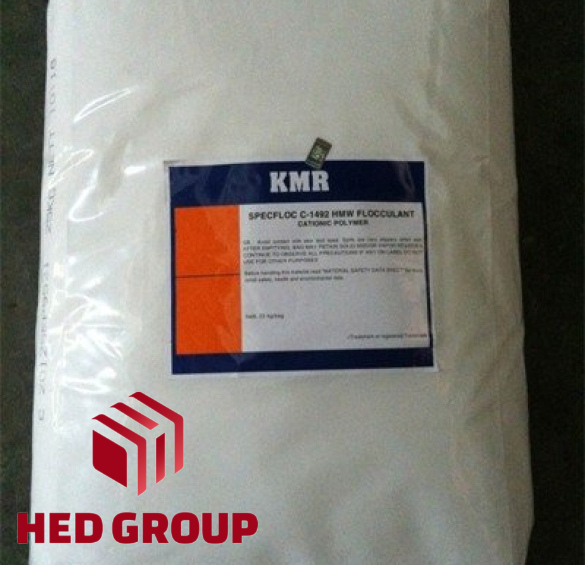
Polymers are chemicals that support the sedimentation process effectively when combined with other coagulants such as PAC, alum, iron salts, etc. There are two types of polymers: cationic polymers and anionic polymers.
Hed Group is a reputable distributor of water treatment polymers. With experience and a professional technical team, Hed Group is committed to providing customers with high-quality products and the best pricing policies.
Principle of Use: Anionic polymer is dissolved in water to form a stock solution, which is then pumped into the system requiring treatment.
Concentration of stock solution: 0.01 – 0.2% by weight Metering pump always operates in automatic mode Extraction concentration: 0.1 – 50ppm
Mixing Method: Add water to the storage tank and then add anionic polymer in proportion to the concentration of the stock solution (the concentration of the stock solution varies depending on the characteristics of each type of water). For example: To prepare a stock solution with a concentration of 0.01%: weigh 0.1kg of Polymer and add it to a 1,000-liter water tank.
Turn on the mixer for 60 minutes to ensure complete dissolution of the polymer in water.
Adjusting Polymer Concentration in the System: Adjust the flow rate of the extraction pump or the concentration of the stock solution so that the flocs are large with the lowest dosage of Polymer used, and the amount of sludge collected in the water sump is minimal.
Cationic polymer, in powder form, is recommended for post-filtration processes such as:
Belt filter presses, centrifuges - increasing product yield, cake formation, and chemical recovery Water clarification - enhancing efficiency, process, and water quality by reducing suspended solids and turbidity Floatation Filtration - improving water filtration quality Thickening - enhancing coagulation and settling
Principle of use: Cationic polymer is dissolved in water to form a stock solution, which is then pumped into the system to be treated.
Concentration of stock solution: 0.01 - 0.2% by weight Metering pump always in automatic mode Extraction concentration: 0.1 - 20 ppm
Mixing method: Pour water into the container, then add cationic polymer in proportion to the concentration of the stock solution (the concentration of the stock solution varies depending on the characteristics of each type of water). Example: To prepare a stock solution with a concentration of 0.01%: weigh 0.1kg of polymer into a container containing 1,000 liters of water.
Turn on the mixer for 60 minutes to completely dissolve the polymer in the water.
Adjusting the polymer concentration in the system: Adjust the flow rate of the extraction pump or the concentration of the stock solution so that the sediment is large with the lowest dosage of polymer used, and the amount of sediment through the water collection compartment is small.
Use clean water, free from suspended solids. Do not use gear pumps, only piston pumps or diaphragm pumps should be used. Excessive stirring will reduce the properties of the polymer, so stirring should not be done when the solution has settled evenly. After a period of use, the polymer will accumulate viscous sludge at the bottom, so we need to pay attention to disperse and remove them to improve water treatment efficiency.
Địa chỉ:
Email:
Phone: